.png)
Ejari and DEWA in Dubai: How They Connect & Setup Guide (2026)
You register Ejari first, then activate DEWA. To open a water-and-electricity account you give DEWA two things from your Ejari: your Ejari number and the property’s DEWA premise number.
KEY TAKEAWAYS
- DEWA activation needs two things from your Ejari: the Ejari number and the premise number.
- The premise number is a 9-digit code for the unit itself, not your Ejari registration number and not your DEWA account number.
- The refundable deposit is AED 2,000 for an apartment or AED 4,000 for a villa, plus a AED 155 supply activation fee. For an office or other non-residential unit, DEWA sets the deposit from the premises’ expected consumption, not a fixed amount.
- Ejari comes first; the exceptions are some free zones (DIFC, for example) and premises the DLD exempts.
Which comes first, Ejari or DEWA?
Ejari. Your tenancy contract has to be registered and the Ejari certificate issued before you can activate DEWA in your name. Once you have the certificate, you start the supply yourself through DEWA’s move-in service.
The premise number is needed on both sides of that sequence: it goes on the DLD tenancy contract when you register Ejari, and DEWA uses the same number again when the supply is activated.
What is the DEWA premise number?
The DEWA premise number (also written "premises number" or "premise no." on some documents) is a 9-digit numeric identifier that DEWA assigns to every metered property in Dubai: apartments, villas, offices, and warehouses. It identifies the physical unit, not the tenant. It does not change when people move in or out, it exists even when the unit is vacant, and it is the same whether or not there is an active DEWA account at the address.
The premise number belongs to the unit, not to the tenant: tenants change, the premise number stays the same.
Format: 9 digits, no letters, no spaces, for example 393123456. On the DEWA plate at the door the same number is usually shown with dashes (393-12345-6); on the bill, on the Ejari form and in DEWA Move In it is entered without them.
Why you need the premise number
You will be asked for the premise number in several steps of a tenancy, not only at DEWA Move In:
- Ejari registration: the field is required on the DLD tenancy contract form.
- Ejari renewal: the premise number must appear on the contract form again when you renew for a new period.
- DEWA Move In: DEWA asks for it, together with your Ejari number, when you activate the supply through the website or app.
- DEWA Move Out: you close the account against the same premise when you leave.
- DEWA support: for a fault, meter reading, or bill query, DEWA uses the premise number to identify the unit.
If you are still preparing the contract, ask the landlord or agent for the premise number before you sign: it belongs on the official DLD form. Our guide to what Ejari is and how to register walks through the full registration step by step.
The premise number, and where to find it
DEWA identifies the property by its premise number, which is a separate 9-digit number from your Ejari number. The fastest source is whichever of these you already have:
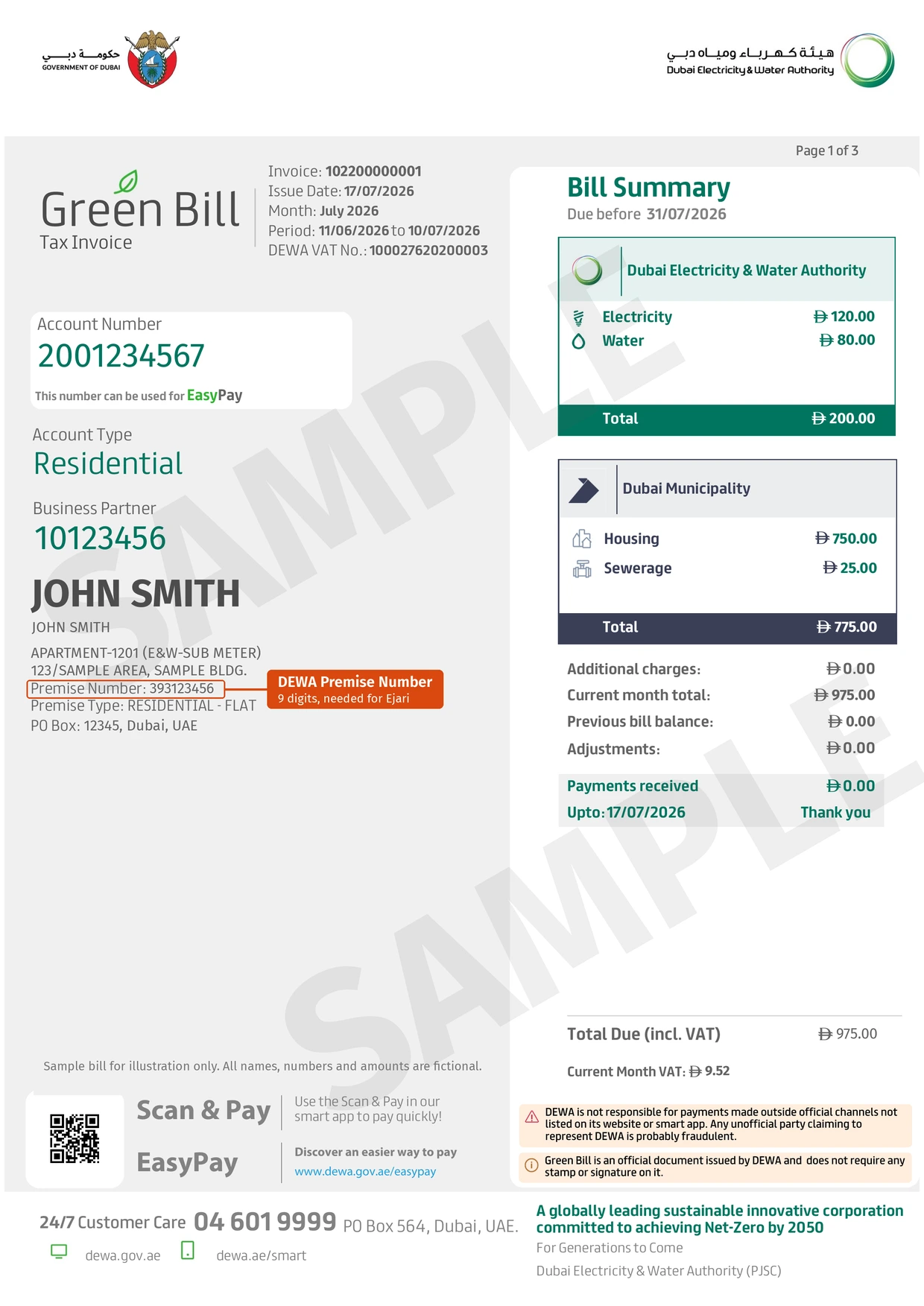
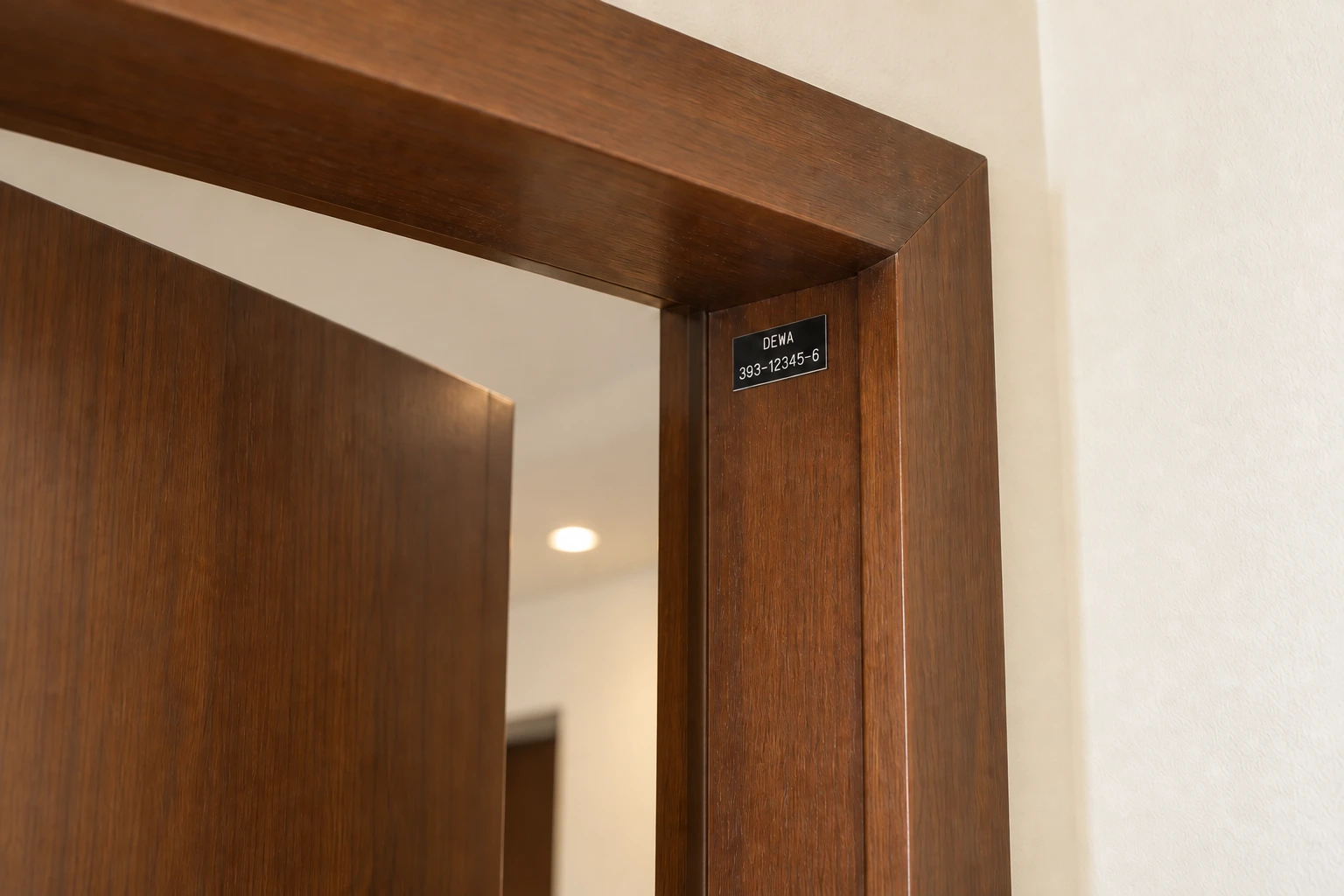
When DEWA asks for the premise number, use the 9-digit premise number, not your Ejari registration number. They are two different numbers.
Premise number vs other Dubai property numbers
Several identifiers appear on Ejari certificates, title deeds, and DEWA bills. They are not interchangeable:
Rule of thumb: premise number = the unit · account number = your contract with DEWA · Ejari number = your registered tenancy.
After Move In, DEWA references your account number on every bill and in the app. You use the premise number once to open that account.
How to activate DEWA once your Ejari is issued
In most cases you do not apply at all. Ejari and DEWA are integrated: when the Ejari is issued, the details transfer to DEWA automatically, DEWA creates the Move In request and the account, and sends an SMS and a welcome email with the new account number and a link to pay the security deposit. Once the deposit is paid, the supply is connected.
If the welcome email does not arrive, apply manually through DEWA's Activation of Electricity and Water (Move-in) service on dewa.gov.ae or in the DEWA app:
- Open the Move In service and select your customer type (tenant or owner, as applicable).
- Enter the Ejari number and the 9-digit DEWA premise number. With a valid Ejari number the fields are prepopulated from the Ejari system, so no documents are needed.
- Pay the refundable security deposit and the AED 155 activation fee (amounts below).
- The supply is connected within 15 working hours of payment.
Either way, you need the Ejari certificate issued before the account can be opened: DEWA validates the Ejari against the premise.
What DEWA activation costs
DEWA charges a refundable security deposit plus a one-time activation fee. For a home the deposit is AED 2,000 for an apartment and AED 4,000 for a villa, with an activation fee of AED 155. For an office or other non-residential unit the deposit is not a fixed amount: DEWA sets it from the premises’ expected consumption. The supply is connected within 15 working hours of payment. Current amounts are on the DEWA move-in service page.
Common mistakes with the premise number
Using the previous tenant's DEWA account number. That number belongs to their closed billing account; Move In needs the premise number for the unit.
Entering the Ejari number instead. The Ejari number is a longer registration number with a version suffix like (v.1); the premise number is 9 plain digits.
What if you cannot find your premise number?
Ask the landlord, agent, or building management first; they usually have it from a previous tenancy, and it is also displayed on the door of the unit. If nobody has it, contact DEWA customer care (current contact options are on dewa.gov.ae). DEWA can look up the premise number using the property address, plot number, or Makani number, so have your tenancy contract ready.
Once you have the number, you can complete Move In or finish the Ejari registration, whichever step you are on.
Getting the deposit back, and moving home
The deposit is refundable. When you move out, you close the account through DEWA's move-out service against the same premise number. DEWA sends the final bill within 24 working hours of the move-out date, the deposit is set against it, and any balance is refunded to you by IBAN transfer, cheque, or transfer to another active DEWA account. If you move to a new home, you do not transfer the deposit: you close the old account and reclaim that deposit, and you pay a new deposit when you activate the new premise. For property owners the rule differs: DEWA refunds an owner's deposit only when the premise is sold.
After Move Out, the Ejari for that unit should be cancelled so the next tenant can register; only one active Ejari is allowed per unit. Our guide to how to cancel Ejari in Dubai covers who does it and how. If you are renewing for another year at the same address instead of leaving, Renew Ejari online on Habi when the tenancy contract is updated for the new period.
The one case where you can activate DEWA without an Ejari
For most homes an Ejari is required first. The exception is property in certain free zones that keep their own registry instead of Ejari, the DIFC being the clearest example, plus a small number of premises that the Dubai Land Department exempts. For those, DEWA can be activated without an Ejari certificate. If you are not sure whether your property is exempt, check with the free zone's own registrar or DEWA customer care before you apply.
If you have not registered your Ejari yet
DEWA is the step after Ejari, so complete the Ejari registration first. You can do that through the DLD's own channels (the Ejari portal, the Dubai REST app, DubaiNow), at a Real Estate Services Trustee centre, through a property management company, or online through licensed companies such as Habi. If you have not signed a tenancy contract for the property yet, you can Create Tenancy Contract on Habi before you register.
Sources
- Dubai Electricity and Water Authority. Activation of Electricity and Water (Move-in) [official service].
URL: https://www.dewa.gov.ae/en/consumer/supply-management/activation-of-electricity-water-move-in.
Accessed: 13.09.2026. - Dubai Electricity and Water Authority. Ejari FAQ [official page].
URL: https://www.dewa.gov.ae/en/consumer/miscellanies/ejari-faq.
Accessed: 13.09.2026. - Dubai Electricity and Water Authority. Deactivation of Electricity and Water (Move-out) [official service].
URL: https://www.dewa.gov.ae/en/consumer/supply-management/deactivation-of-electricity-water-move-out.
Accessed: 13.09.2026.