.png)
Tenancy Contract Template in Dubai: Download and Field-by-Field Guide
The official tenancy contract template in Dubai is the unified Ejari tenancy contract published by the Dubai Land Department: a free download from the DLD website, bilingual in Arabic and English. This guide explains what each field of the template means, which details registration requires, and what the template does not cover: the addendum, where the parties record their agreed conditions.
KEY TAKEAWAYS
- The official template is the unified Ejari tenancy contract published by the DLD, free and bilingual. Use the latest version from the DLD page: older versions may be missing fields that Ejari registration now requires.
- The template holds the standard terms: the parties, the property, the term, the rent and contract value, the payment mode, and the deposit. Everything the parties agree beyond that goes into the addendum.
- Complete the fields from documents, not from memory: names exactly as on the ID documents, the property exactly as on the title deed.
Where to download the tenancy contract template
The official template is the unified Ejari tenancy contract published by the Dubai Land Department, a free download from the DLD e-services. It is bilingual: every field appears in Arabic and English.
Take the latest version from the DLD page rather than reusing an older file. Older versions may be missing fields that Ejari registration now requires, and a missing field means a returned registration.
Editable tenancy contract template (PDF)
The file on the DLD page cannot be typed into: the fields are there, but the page is a flat image, so on a computer you would first have to place a text box over every line with a PDF editor. The editable version below is the same template, current DLD version, with a text field already on every line: open it in any PDF viewer (Preview, Adobe Reader, Chrome), type, then print or sign electronically. Wording and layout are the DLD's, unchanged; the only addition is a Contract No. line at the top, which the addendum quotes so that the two documents cannot be mismatched.
- Unified tenancy contract, editable PDF: the DLD template with a field you can type into on every line [unified-tenancy-contract-editable-pdf-dubai.pdf]
Addendum template (Word)
To finalise a lease yourselves you need a second document: the addendum, where the parties record the conditions the contract has no field for. There is no official form; the template below is a standard residential addendum whose clauses follow Law No. 26 of 2007 as amended and current market practice in Dubai. What each clause is for is explained further down.
- Addendum template, Word: a standard residential addendum with blanks for the agreed terms [tenancy-contract-addendum-template-dubai.docx]
A completed example of each document is in the next section.
The same contract and addendum can be created on Habi instead of filled in. The step-by-step online flow asks for each detail in turn and places it where it belongs, produces the addendum with the agreed terms, and the documents are ready in minutes: sign them online or download them, then register with Ejari. Create tenancy contract online.
What a completed tenancy contract and addendum look like
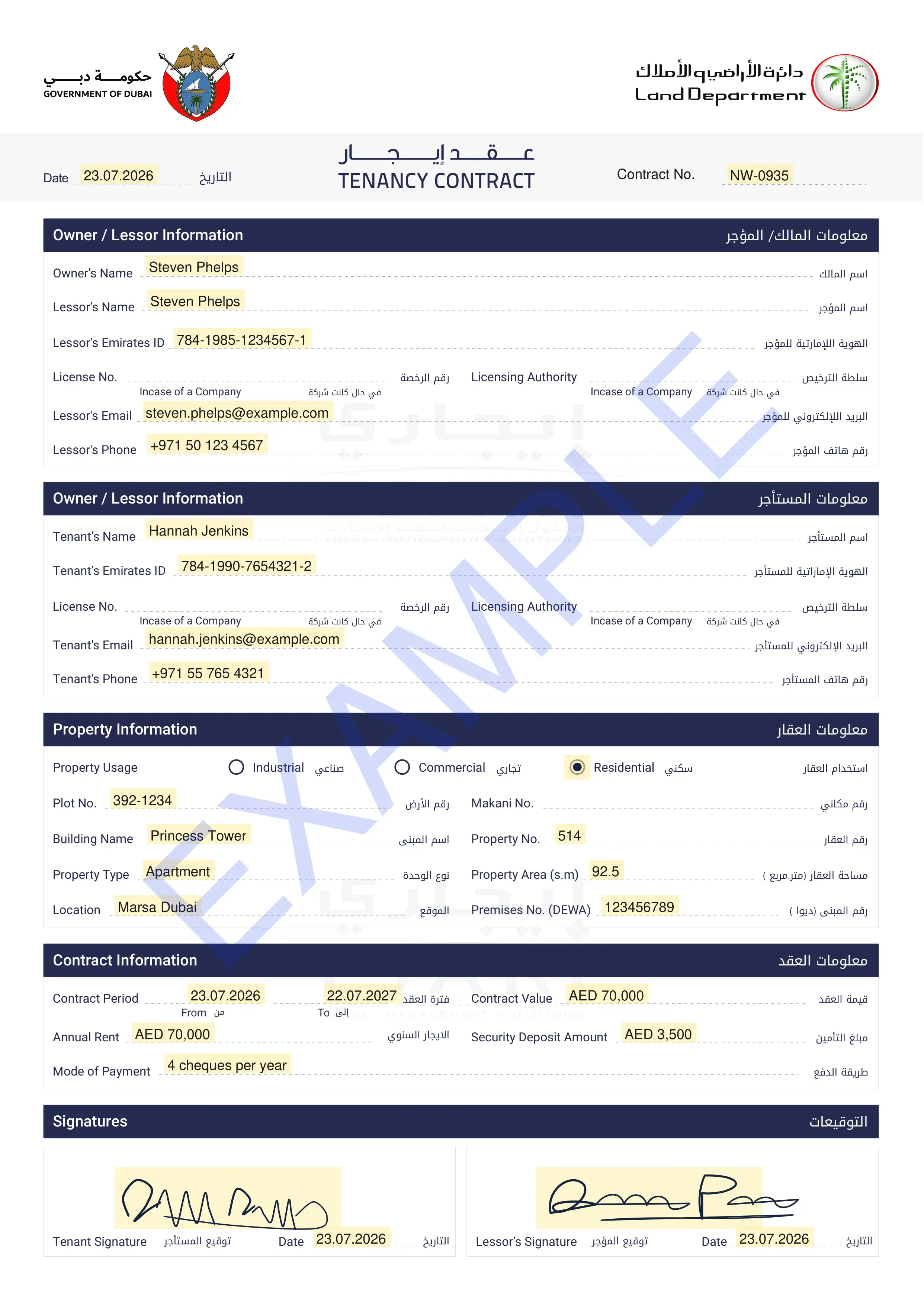
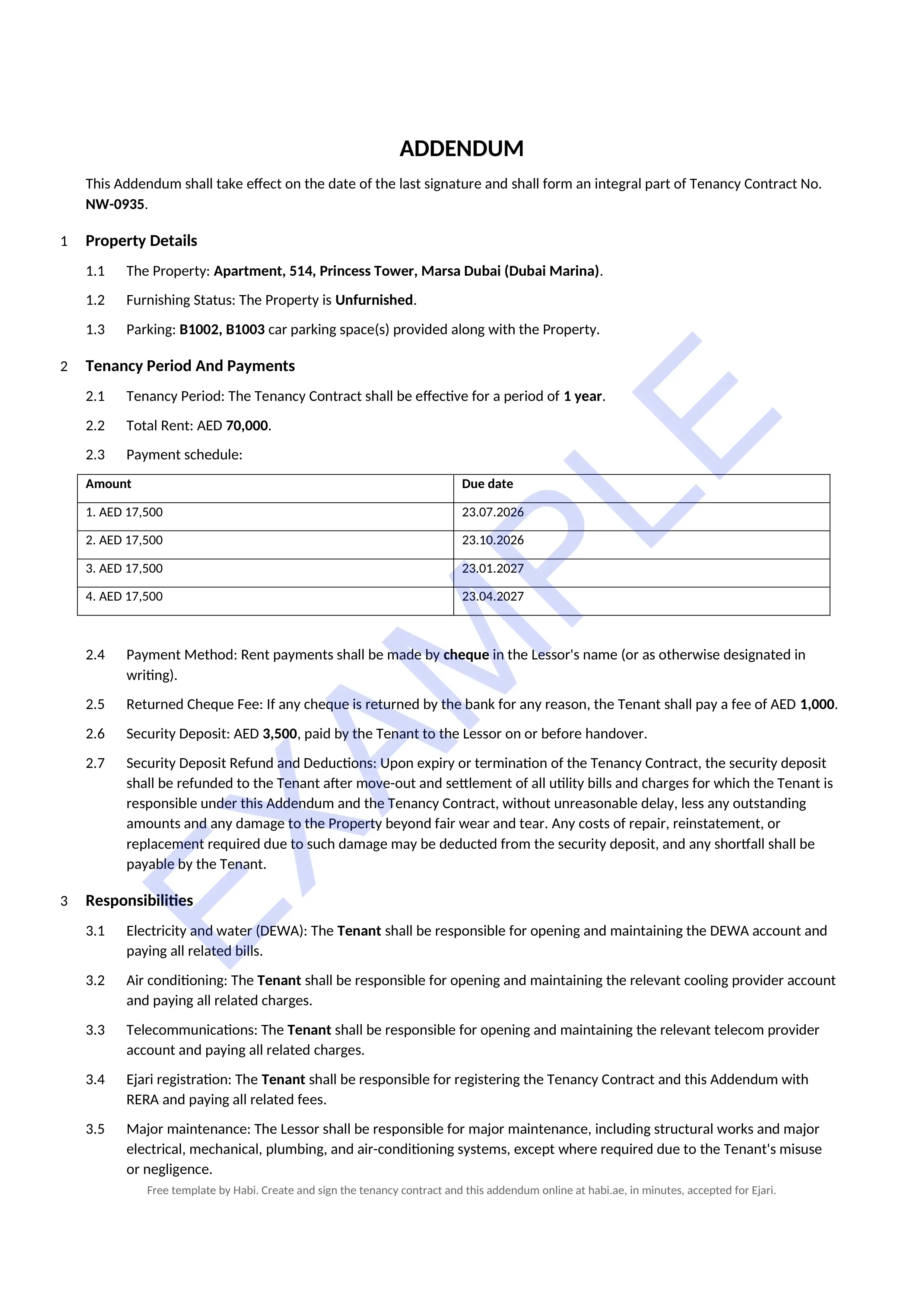
The example below is the unified tenancy contract and the addendum completed for a one-year lease of an apartment in Dubai Marina: AED 70,000 a year, four cheques, a 5% deposit. Click either document to open the full PDF. Names and figures are fictional; the guide below refers to this example field by field.
The template's fields, explained
Fields in the order they appear on the editable PDF. "In the example" refers to the completed example above: a one-year lease of an apartment in Dubai Marina. Its figures are one deal's figures, not a norm; every property and every deal is different.
- Date and Contract No. The date the contract is signed. Contract No. is any reference the parties choose; the addendum quotes it. In the example: 23.07.2026, NW-0935.
- The parties. Complete names exactly as on the ID documents: the landlord as on the passport, the tenant as on the Emirates ID. A company enters its trade licence number and the licensing authority (for example DET or DMCC). The tenant's mobile number must be a local UAE number. The document set itself is in documents required for a tenancy contract. Owner and lessor are the same person unless someone lets the property on the owner's behalf under a power of attorney; the licence fields stay empty for individuals. In the example: Steven Phelps as owner and lessor, Hannah Jenkins as tenant, Emirates ID numbers, email and phone for both.
- Property usage. Tick one: Residential for an apartment or villa. The editable PDF allows only one choice.
- The property. Details exactly as on the title deed, including the plot number, plus the DEWA premise number, which is printed on the DEWA bill and on the meter. Location is the area name as written on the title deed. Makani number is not required for Ejari registration as of 2026. In the example: plot 392-1234, Princess Tower, property no. 514, Apartment, 92.5 sq m, location Marsa Dubai (Dubai Marina), premise number (DEWA) 123456789.
- The term. The start and end dates. A renewal starts the day after the previous contract expires. Note the year boundary: a full year starting 1 January ends 31 December; running it to 1 January adds a day, and the contract value must then exceed the annual rent by one day's rent. In the example: 23.07.2026 to 22.07.2027.
- Annual rent. The rent for one year, figures only. Extra text in this field is a common cause of returned registrations. In the example: AED 70,000.
- Contract value. The total rent for the whole contract period. For a one-year contract it equals the annual rent; for any other period it is the rent recalculated for the exact term. In the example: AED 70,000.
- Payment mode. How the rent is paid: the number of payments per year and the method, usually cheques or bank transfer, though other methods exist. In the example: 4 cheques per year. The dates and amounts of each cheque go into the addendum.
- Security deposit. The agreed amount. By market practice it is around 5% of the annual rent unfurnished and around 10% furnished. In the example: AED 3,500.
- Additional terms. Five lines on page 3 for short conditions. Anything longer goes into the addendum; the example uses two lines for two general clauses and leaves the rest to the addendum.
- Signatures. Both parties sign and date all three pages; the signature blocks are on each page.
Every field above feeds Ejari registration, and incomplete or mismatched entries are the usual reasons a registration is returned. The step-by-step process of making the contract, from gathering the details to signing, is in our guide to making a tenancy contract in Dubai.
What the template does not cover: the addendum
The template holds the standard terms only. The conditions the parties agree beyond it are recorded in the addendum: separate pages drafted by the parties, signed by both, and attached to the contract. There is no official addendum form, and its conditions must not contradict rental laws and regulations. The conditions experienced landlords and tenants set out there:
- the payment schedule, written out cheque by cheque
- who pays for which utilities
- minor maintenance and its threshold
- early termination: the notice period and the compensation
- penalties for a bounced cheque or late payment
- viewing access near the end of the term
- the inventory list, for furnished properties
You can see a completed addendum in the example above. The addendum template in the download section covers all of these except the inventory list, which is attached separately for furnished properties; its blanks are explained in the next section.
If the tenancy contract is created on Habi, the addendum is included: the parties set up their terms in the flow, and the addendum comes out with those terms correctly laid out, attached to the latest version of the DLD template.
The addendum template, clause by clause
The template has five parts. Fixed clauses are written out in full; the blanks are the terms the parties agree. "In the example" refers to the completed addendum above, the same Dubai Marina lease; its figures are the example's, not a norm.
- Heading. The contract number from the Contract No. field of the tenancy contract. In the example: NW-0935.
- Property details. The property as on the contract, plus two things the government template has no field for: the furnishing status (furnished, unfurnished or partly furnished) and the parking bays that come with the property. In the example: Apartment, 514, Princess Tower, Marsa Dubai (Dubai Marina); unfurnished; bays B1002 and B1003.
- Tenancy period and payments. What the government template cannot hold: the period written as a duration for clarity (1 year, 2 years, 1 year and 2 months) alongside the contract dates; the payment schedule with the exact amount and due date of every cheque or transfer, so there is no ambiguity; the fee for a returned (bounced) cheque; and the conditions of the deposit refund: after move-out and settled bills, less damage beyond fair wear and tear. The total rent and the deposit repeat the contract's figures. In the example: 1 year; AED 70,000 as four cheques of AED 17,500 due 23.07.2026, 23.10.2026, 23.01.2027 and 23.04.2027; cheque; AED 1,000 returned-cheque fee; AED 3,500 deposit.
- Responsibilities. The government template puts all utilities on the tenant and maintenance on the landlord, in both cases "unless otherwise agreed in writing". The addendum is where that is agreed precisely or changed: who holds and pays each account (DEWA, cooling, telecom), who registers the contract with Ejari, and the split between major maintenance (structure, main electrical, plumbing and air-conditioning systems, on the landlord) and minor day-to-day repairs (on the tenant, up to a threshold per repair). In the example: Tenant for all four accounts and for Ejari registration; minor repairs by the tenant up to AED 1,000 per occurrence.
- Renewal and termination. Renewal and termination by the landlord follow the law and repeat what the government template already says; parties often restate them in the addendum for clarity. The clause that matters is early termination by the tenant: the notice period and the compensation, both in months, without which the tenant has no agreed way out before the end date. In the example: two months' notice and two months' rent.
- General. Clauses that come from the experience of Dubai landlords and tenants and settle situations the government template is silent on: the condition the property is returned in, closing the utility accounts before handover, access on 24 hours' notice, viewings near the end of the term (which a tenant can refuse if the clause is not there), liability for fines, amendments in writing, electronic signatures. Nothing to fill in; read them.
- Signatures. Name, signature and date for each party. The addendum takes effect on the date of the last signature.
After the documents are filled in
- Sign both documents in whichever way suits both parties: printed and signed by hand, or signed electronically. Both parties sign and date all three pages of the contract and the signature block of the addendum; each keeps a full set. Ejari accepts either form of signature when the signatures match the ID documents provided.
- Register the contract with Ejari, with the addendum attached. Registration is the landlord's responsibility unless the addendum assigns it to the tenant. It is done online through Habi (register Ejari online), through the Dubai REST app for landlords, or at a registration trustee office.
Ways to get a completed contract
- Fill it yourselves. Download the DLD template, complete the fields from the documents, and draft the addendum. This is the route this guide supports. The templates and the completed example are above.
- Create tenancy contract online. Either party creates the tenancy with the addendum included and shares it with the other for review and signing.
- Through an agent. The agent who arranges the lease usually prepares the contract. Trustee centres that draft contracts for a fee typically produce the standard template only, without an addendum.
- Through a property management company, where the property is under a management contract.
Sources
- Dubai Land Department. Download Unified Ejari Tenancy Contract [e-service].
URL: https://dubailand.gov.ae/en/eservices/ejari-templates/download-unified-ejari-tenancy-contract/#/.
Accessed: 13.09.2026. - Dubai Land Department. Register / Renew Rental Contract [e-service].
URL: https://dubailand.gov.ae/en/eservices/register-renew-ejari-contract/.
Accessed: 13.09.2026.